sshush
sshush is an interactive terminal UI (TUI) for managing SSH keys, the
ssh-agent, and your ~/.ssh/config — an SSH key manager, agent controller,
config editor, and connection launcher in one keyboard-driven app, written in
Go. Switch keys, see what’s loaded in the agent, browse and connect to hosts,
and edit your config safely without leaving the terminal.
Status: in active development. Edits to your SSH config are gated behind a confirmation and a
.bakbackup is written before the first change, but treat it as pre-1.0 software.
Features
- Keys pane — every key pair in
~/.ssh, its algorithm, fingerprint, agent load state (●loaded /○not), the default key (★), and which hosts use it (↪ host, …). - Agent integration — load/unload a key (
ssh-add), unload everything (ssh-add -D), and see agent-only keys that aren’t on disk. - Hosts pane — hosts from
~/.ssh/configand itsIncluded files with their connection details (user@hostname:port), including wildcard (Host *) and read-onlyMatchblocks. - Connect to a host — press
Enteron a host tosshinto it; your own config (ProxyJump,IdentityFile, …) applies, and the terminal is handed to the session. Under a custom config location (config_path/SSHUSH_CONFIG/ssh_dir), the connection runsssh -F <config> <alias>so aliases resolve against the right file with full wildcard/Matchfidelity. - Copy to clipboard —
ccopies a key’s public key or fingerprint, or a host’s ready-to-runsshcommand — an explicit invocation expanded from the host’s own block (-p/-i/-oflags), shell-quoted for safe pasting (needsxclip/wl-clipboardon Linux). - Scroll & search — panes scroll for long lists (
PgUp/PgDn,g/G);/filters the active pane (keys by name/comment/algorithm, hosts by name/hostname/user). - Edit config in place — change
HostName/User/Port, add/edit/delete any directive (e.g.ForwardAgent yes), add or delete whole hosts (guided wizard), and attach/detach keys to a host (IdentityFile). Formatting and comments are preserved; a backup is written first. - Security checks — audit and fix loose
~/.ssh/key permissions (P), and browse or removeknown_hostsentries (K). - Restore from backup —
R(orsshush restore) reverts the config to the.baksnapshot written before the session’s first edit, so a bad change is one keystroke to undo. - Generate & delete keys —
ssh-keygenwrapper; the new-key wizard prompts for algorithm, size, file name, and a key comment (-C, defaulting to the file name). Deleting a key also removes it from the agent. - Default identity — mark a key as default and have it auto-loaded into the
agent on startup (in-app, or on every shell via
sshush shell-init). - Themes & motion — 16 built-in color themes (foreground + background) with a
live in-app switcher (
t), plus an opt-in motion/animation system (m). - Hot reload — external changes to your config or
~/.sshare picked up automatically.
Themes
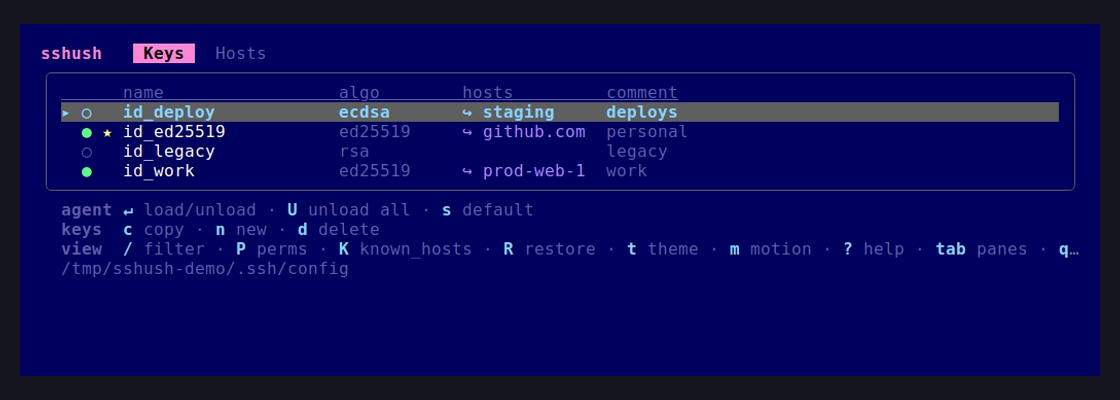
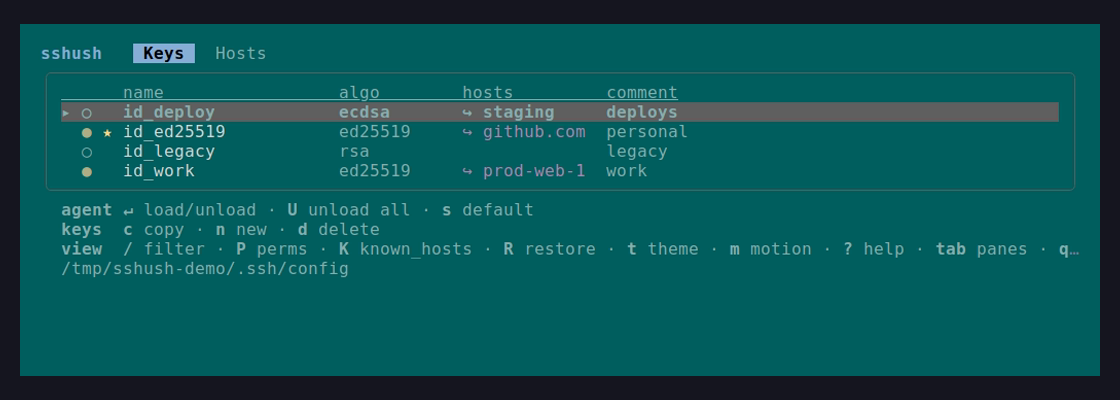
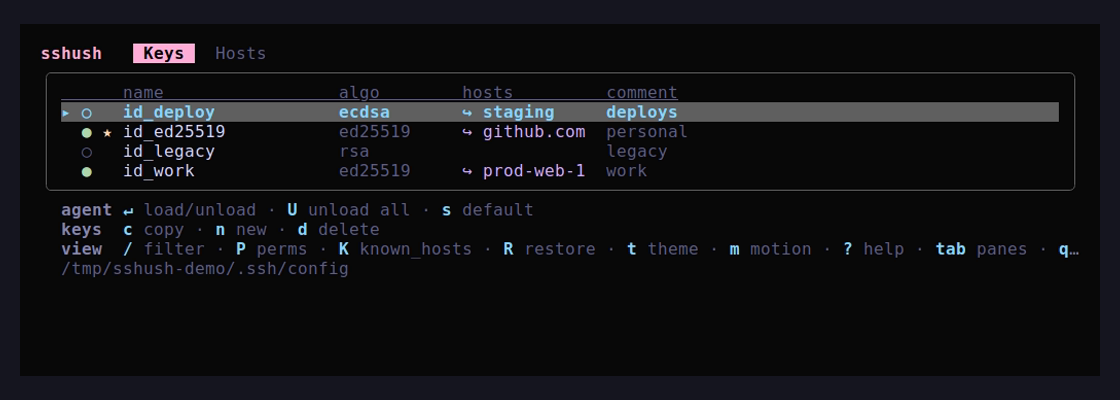
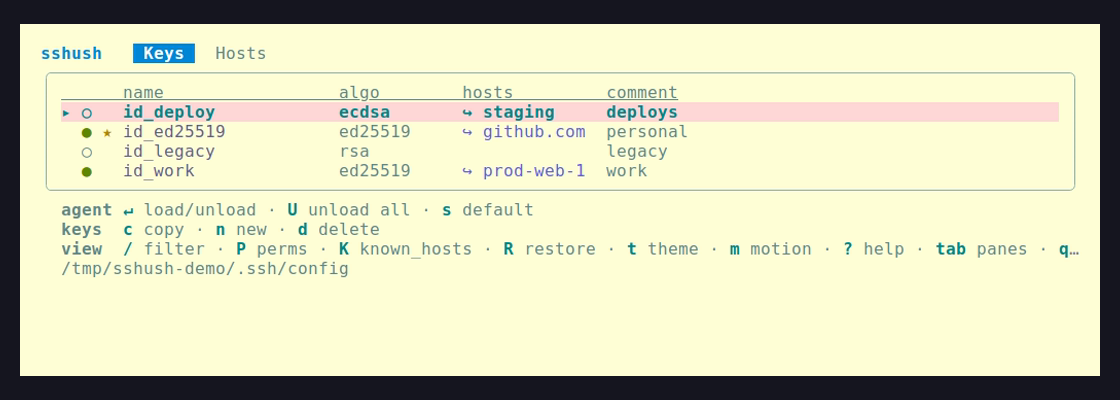
16 built-in color themes (foreground + background), switchable live with t —
Dracula, Nord, Gruvbox, Solarized, Catppuccin, Tokyo Night, and more:
| Dracula | Nord |
|---|---|
 |
 |
| Catppuccin Mocha | Solarized Light |
 |
 |
Requirements
- Go 1.25+ (to build from source)
ssh-agent,ssh-add,ssh-keygenon yourPATH- A running agent (
echo $SSH_AUTH_SOCKshould be non-empty) for agent features - (Linux)
xclip,xsel, orwl-clipboardfor clipboard copy (c); macOS and Windows use the native pasteboard
Install
Homebrew (macOS / Linux)
brew install s-johri/tap/sshush
Arch Linux (AUR)
yay -S sshush-bin # or: paru -S sshush-bin
Both ship shell completions and the man page (man sshush).
Install script
curl -fsSL https://raw.githubusercontent.com/s-johri/sshush/main/install.sh | sh
Detects your OS/arch, downloads the matching release archive, verifies its
checksum, and installs sshush to ~/.local/bin (override with INSTALL_DIR).
Pin a version with SSHUSH_VERSION=v0.7.0.
Prebuilt binary
Download the archive for your OS/arch from the
latest release, extract it,
and put sshush on your PATH. Once installed from a release, update in place:
sshush update    # fetches the latest release and replaces the binary
sshush version   # show the installed version
Build from source
git clone https://github.com/s-johri/sshush.git
cd sshush
go build -o "$(go env GOPATH)/bin/sshush" ./cmd/sshush
Make sure $(go env GOPATH)/bin is on your PATH.
Run the tests with go test ./.... The end-to-end suite (a throwaway
ssh-agent, key, and config) is behind a build tag — go test -tags e2e ./...
— and needs ssh-agent/ssh-add/ssh-keygen on your PATH.
go install
go install github.com/s-johri/sshush/cmd/sshush@latest
Shell completions
The Homebrew and AUR packages install completions automatically. For a manual
install, run sshush install-extras to write the embedded man page and all three
completion scripts to your user directories (XDG paths); sshush update and
install.sh refresh them. Or print a single script yourself:
sshush install-extras   # man page + bash/zsh/fish completions → user dirs
sshush completion bash > /etc/bash_completion.d/sshush
sshush completion zsh  > "${fpath[1]}/_sshush"
sshush completion fish > ~/.config/fish/completions/sshush.fish
Usage
sshush              # launch the interactive TUI
sshush load-default # load the configured default identity into the agent
sshush shell-init   # print a shell snippet to load the default on shell start
sshush restore      # revert the SSH config to the backup from before edits
sshush update       # update to the latest release
sshush version      # print the installed version
sshush completion <shell>  # print a bash/zsh/fish completion script
sshush install-extras      # install the man page + completions to user dirs
sshush help         # show help
Keybindings
Keys pane
| Key | Action |
|---|---|
↵ enter / space |
load / unload the selected key in the agent |
U |
unload all keys from the agent |
s |
toggle the selected key in/out of the startup defaults |
c |
copy the public key or fingerprint to the clipboard |
n |
generate a new key (ssh-keygen) |
d |
delete the selected key’s files (irreversible) |
Hosts pane
| Key | Action |
|---|---|
↵ enter |
ssh into the selected host |
e |
edit host directives (tab to cycle, ctrl+o add option, ctrl+d delete) |
i |
attach / detach keys for the host |
c |
copy a ready-to-run ssh command to the clipboard |
n |
add a new host (guided wizard) |
d |
delete the host |
Read-only Match blocks are shown for reference; edit/connect actions are
declined on them.
Anywhere
| Key | Action |
|---|---|
tab / ← → |
switch panes |
↑ ↓ / k j |
move |
PgUp PgDn, g G |
page / jump to top / bottom |
/ |
filter the active pane (esc clears) |
P / K |
permission audit / known_hosts |
R |
restore config from backup (undo edits since session start) |
t / m |
switch theme / toggle motion |
? |
full keybinding help |
r |
refresh |
q / ctrl+c |
quit |
Writes are confirmed with y / n; esc cancels an overlay.
Load the default key on shell startup
Mark a key as default in the TUI (Keys pane → s), then add the snippet to your
shell rc so each new shell loads it:
sshush shell-init >> ~/.bashrc # or ~/.zshrc
The snippet only runs if sshush is on your PATH, and load-default is a
no-op when the keys are already loaded — cheap and safe to run on every shell.
shell-init warns (on stderr) if the snippet is already in a shell rc, so you
don’t add it twice; the TUI also nudges you to install it when you set a default.
Configuration
sshush stores its own settings (separate from ~/.ssh/config) at
$XDG_CONFIG_HOME/sshush/config.toml (default ~/.config/sshush/config.toml):
# Keys auto-loaded into the agent on startup (toggle with `s` in the TUI).
default_identities = ["id_ed25519", "id_work"]

# Optional: point sshush at a non-default SSH location.
# ssh_dir resolves relative Includes and ~ in the config; config_path defaults
# to <ssh_dir>/config when only ssh_dir is set.
ssh_dir = "~/.ssh"
config_path = "~/.ssh/config"

# Optional: color theme (sets foreground + background). Switch live in-app with
# `t`. Presets: default, mono, high-contrast, dracula, nord, gruvbox-dark,
# gruvbox-light, solarized-dark, solarized-light, catppuccin-mocha,
# catppuccin-macchiato, catppuccin-frappe, catppuccin-latte, tokyonight,
# tokyonight-storm, tokyonight-day.
theme = "default"

# Optional: check for a newer release on launch (default true). The check is
# async and best-effort; a notice appears in the status line if an update exists.
check_updates = true

# Optional: opt-in motion/animation (off by default). Toggle in-app with `m`.
[motion]
enabled = false
intensity = "normal"   # subtle | normal | arcade
default_identities is managed from the TUI (s toggles a key in/out; all are
loaded on startup). An older default_identity = "..." is migrated automatically.
The path overrides can also come from the environment (which takes precedence):
export SSHUSH_SSH_DIR=~/work/.ssh
export SSHUSH_CONFIG=~/work/.ssh/config
The keys above are the stable config.toml schema (frozen as of the v0.9.0
release candidate): within the 1.x line they are never removed or repurposed,
only added. Parsing is forward-compatible — an unknown key is ignored, with a
sshush: unknown setting "…" (ignored) warning on stderr at startup so typos and
stale keys stay visible.
How it works
sshush merges three sources into one view on each refresh:
- key pairs scanned from
~/.ssh, - hosts parsed from
~/.ssh/config(followingIncludes), - identities currently loaded in the agent,
matching disk keys to agent keys by SHA256 fingerprint. Config writes go through a round-tripping parser so comments, ordering, and unknown options survive edits. See ARCHITECTURE.md for the design.
Looking for the YAML config generator?
There is an unrelated, similarly named project:
bencromwell/sshush generates a static
ssh_config file from YAML source files. This sshush is different — an
interactive TUI that works with your existing ~/.ssh/config directly and also
manages keys, the ssh-agent, known_hosts, and permissions. If you arrived
here looking for the YAML tool, the link above is what you want.
Changelog
See CHANGELOG.md for the per-release history.
License
MIT — see LICENSE.